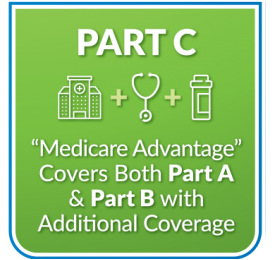
Medicare Advantage, or also known as Medicare Part C, is a bundled Medicare plan offered by private insurance companies. These private companies work with Medicare and make sure they provide full benefits to all beneficiaries.
In a Medicare Advantage plan, private insurance companies work with Medicare to offer parts A and B medicare plans with some additional services called “Part C.”
A recent survey proved that 34% of all people with Medicare also have are enrolled with Medicare Advantage plans such as HMO or PPO.
Medicare regularly pays a fixed amount for your health expenses to the companies offering private Medicare advantage plans. These companies follow the rules set by Medicare that can change each year.
A variety of options to choose from when you opt for the Medicare C plan as:
Special needs plans
Medicare medical savings account plans
Private fee-for-service plans
Health maintenance organization plans
Preferred provider organization plans
Medicare Part C covers:
A Medicare Advantage Plan covers everything that is included in Part A and Part B.
Medicare Part C Costs
Various factors determine the Medicare Part C costs, including deductibles, copayments, premiums, and coinsurance.
There are also various costs associated with Medicare Part C plans, including:
Premiums
Deductibles
Co-pays
Coinsurance
Medicare Part C Enrollment
Medicare C enrollment period (IEP) starts from 3 months before a person turns 65. During this period, a person can get enrolled in:
Medicare Parts A and B
Medicare Advantage (Part C)
Medicare Part D Prescription Drug Plans
Medicare Part C Eligibility
To enroll in Medicare part C a person needs to meet two eligibility conditions:
Currently enrolled in Original Medicare both Parts A and B
Reside where the insurance provider offers the coverage that they require.
This plan is also available during its application or enrollment period.